
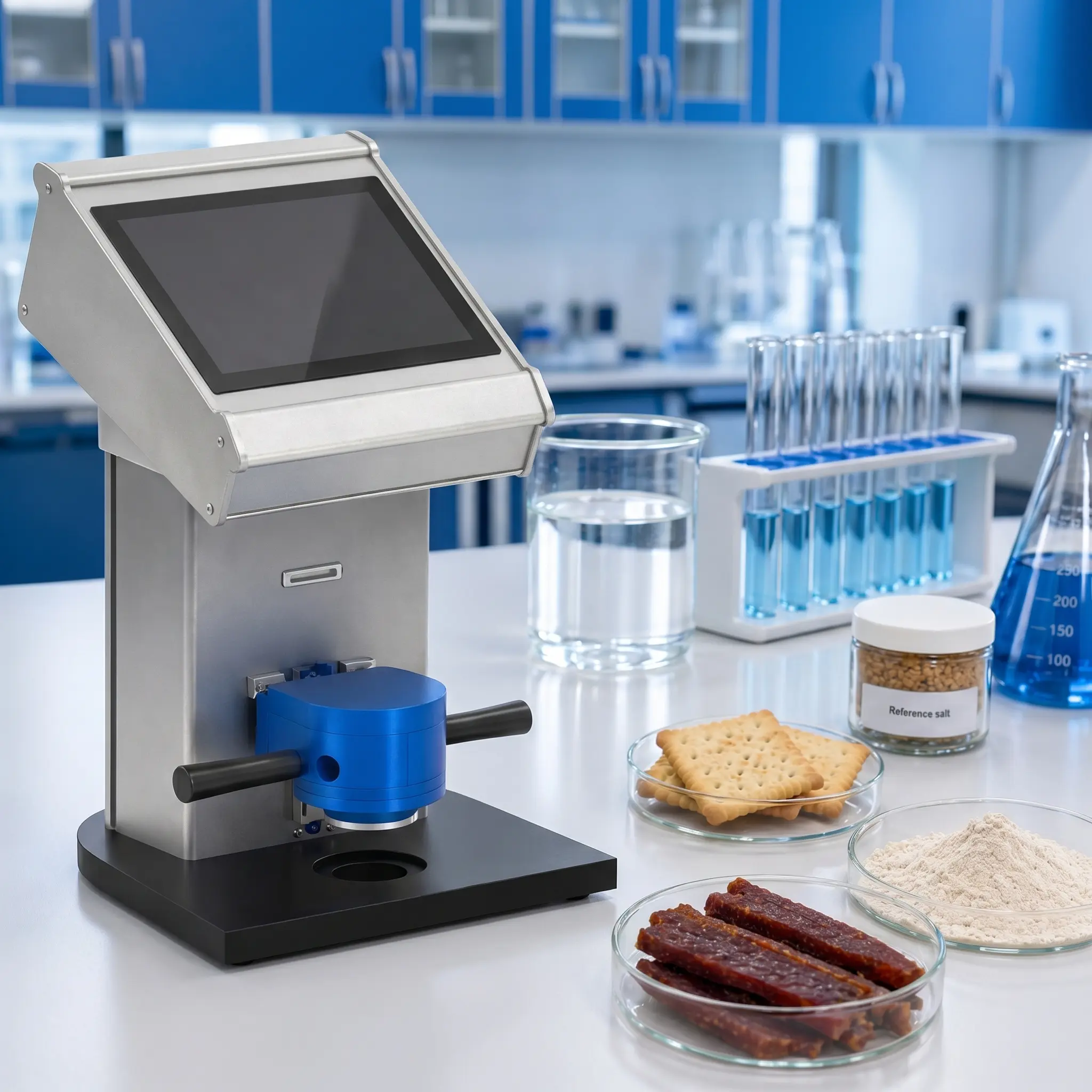
In the quality control of food, pharmaceutical, and cosmetic products, water is the number one enemy of stability. However, confusion often persists between two essential measurements: moisture content and water activity (aw).
If you only measure one of the two, you risk missing crucial information regarding the safety and integrity of your products. Here is why.
Moisture Content: A Matter of Quantity
Moisture content (or water content) is a quantitative measurement. It indicates the total amount of water contained in a sample, expressed as a percentage (%).
- How is it measured? Generally by gravimetry (loss on drying): the sample is weighed, heated to evaporate the water, and then weighed again.
- What it tells us: “How much water is in this product?”
- Its limits: It makes no distinction between chemically “bound” water and “free” water.
Water Activity (aw): A Matter of Quality
Water activity is a qualitative and thermodynamic measurement. It defines the energy state of the water, specifically its “availability” for chemical reactions or the growth of microorganisms.
- How is it measured? Using precision sensors (such as GBX’s ASIC technology) that measure the equilibrium vapor pressure.
- What it tells us: “How available is the water for bacteria to grow?”
- Its value: It is measured on a scale from 0 to 1.
Why Confusion Can Harm Your Production
Imagine two products with the exact same moisture content (e.g., 15%).
- The first is stable and keeps for months.
- The second develops mold within three days.
Why? Because in the first product, the water is “trapped” (bound to proteins or sugars), whereas in the second, the water is “free” (high aw), allowing bacteria to feed on it.
Did you know? Most bacteria stop growing below aw=0.90, and molds stop below aw=0.70.
The Benefits of Measuring Water Activity (aw)
Switching to systematic water activity measurement allows you to:
- Predict Shelf Life: Know exactly when your product is likely to degrade.
- Ensure Microbiological Safety: Essential for HACCP and ICH Q6B compliance.
- Control Texture: Prevent biscuits from softening or powders from clumping (caking).
- Save Energy: No need to over-dry a product if its aw is already stabilized.
Conclusion
Moisture content helps you manage yields and raw material costs. However, water activity is what guarantees the long-term safety and quality of your products.
Bonus Section — Pharma Focus: Molecular Stability and Regulatory Compliance
In the pharmaceutical industry, measuring water activity (aw) is more than a freshness indicator; it is a Critical Quality Attribute (CQA). Unlike moisture content, aw allows for the control of specific risks:
- API Stability: Many drugs are sensitive to hydrolysis. Even with low moisture content, high water activity can trigger the chemical degradation of the active ingredient.
- Phase Transitions: Water activity influences the shift from amorphous to crystalline states. Poor control can alter the drug’s dissolution rate and its therapeutic efficacy.
- Pharmacopeia Compliance: Standards such as USP <1112> recommend using aw as a strategy to reduce microbial limits testing on non-sterile dosage forms.
- Packaging Integrity: It helps validate the effectiveness of blisters and bottles against moisture migration.
GBX Insight: For your FDA or ANSM audits, our eFWM systems support 21 CFR Part 11 compliance, ensuring full traceability and data integrity for all your measurements.
Frequently Asked Questions (FAQ’s)
Q1: What is the difference between moisture content and water activity?
Moisture content measures the total amount of water in a product, expressed as a percentage. Water activity (aw) measures how “free” or available that water is for chemical reactions and microbial growth. Two products can have the same moisture content but very different water activity levels, making aw the more reliable indicator of product safety and stability.
Q2: How do you calibrate a water activity sensor?
Water activity sensors are calibrated using certified salt solutions with known aw values (such as sodium chloride or lithium chloride solutions). The sensor is exposed to these reference solutions at a controlled temperature, and readings are adjusted accordingly. GBX instruments feature built-in ASIC technology that ensures high precision and minimal calibration drift over time.
Q3: What is water activity in cosmetics?
In cosmetics, water activity (aw) is a critical parameter that determines product stability and microbiological safety. A high aw in creams, lotions, or gels can encourage bacterial and mold growth, reducing shelf life. Measuring aw helps formulators ensure their products remain safe and stable without over-relying on preservatives.
Q4: What is the safe water activity level for food products?
Generally, most bacteria stop growing below aw = 0.90, yeasts below aw = 0.80, and molds below aw = 0.70. For long-term shelf stability, most dry food products should have an aw below 0.60. These thresholds are widely referenced in HACCP guidelines and food safety regulations.
Q5: Why is water activity important in the pharmaceutical industry?
In pharma, water activity is a Critical Quality Attribute (CQA). It directly affects the stability of active pharmaceutical ingredients (APIs), controls phase transitions between amorphous and crystalline states, and ensures compliance with standards like USP <1112> and 21 CFR Part 11. Monitoring aw helps prevent chemical degradation and guarantees product efficacy throughout its shelf life.
Request a Technical Reference
Get in touch with our team for a personalized quote, technical
documentation, or product demonstration.
